
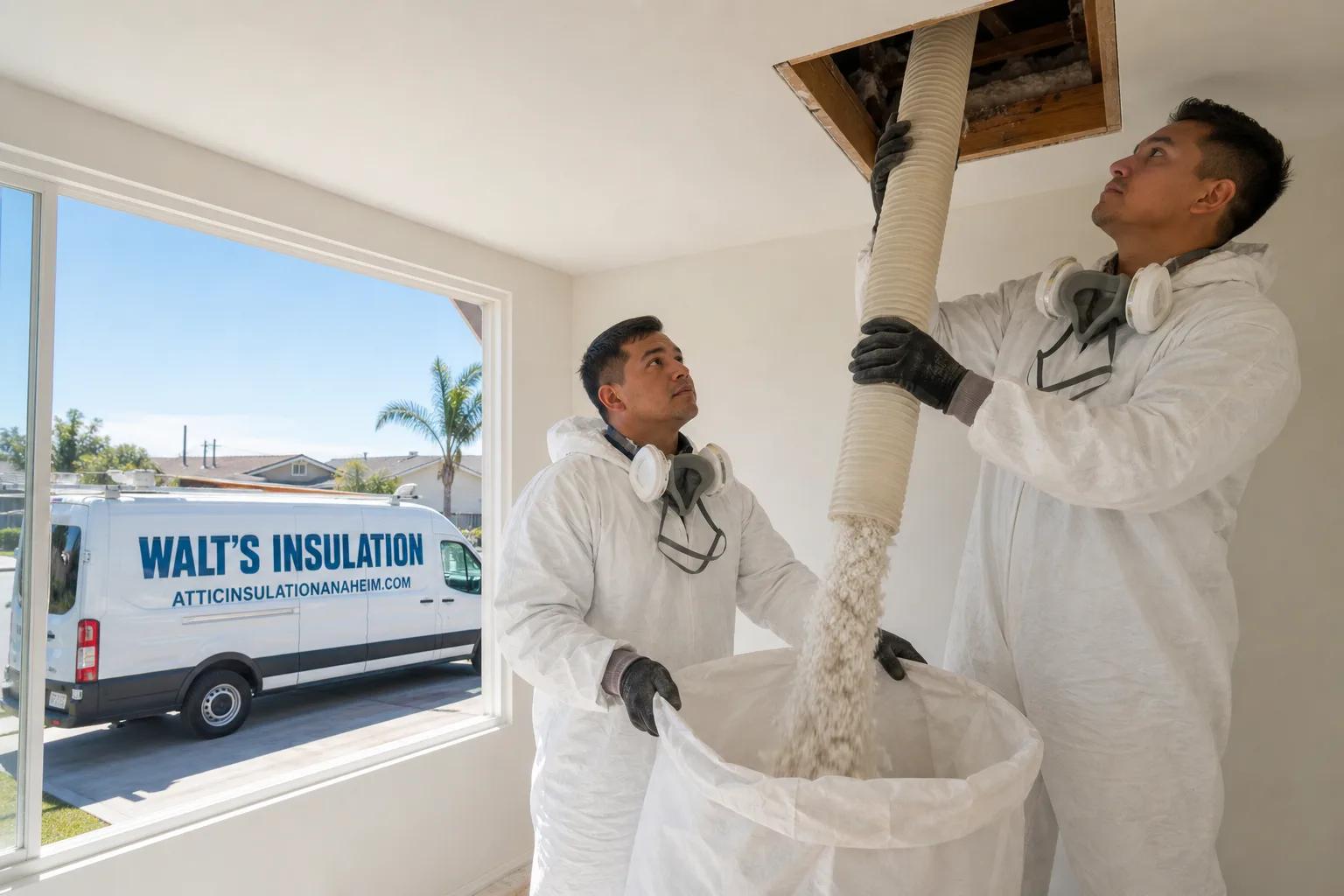
How Much Does Blown-In Insulation Cost in Anaheim?
Blown-in insulation in Anaheim, CA typically costs between $1,200 and $3,800 for a standard attic, depending on square footage, current insulation levels, and material choice. Most Anaheim homeowners pay around $1,800 to $2,400 to bring an average attic up to California’s recommended R-38 to R-60 range. Walt’s Insulation offers Blown-In Insulation services with free on-site estimates and no trip charge in Orange County, so you’ll know your exact number before any work begins.
Blown-In Insulation Cost Breakdown (2026)
Prices below reflect what Anaheim homeowners are actually paying in 2026 – not national averages pulled from a spreadsheet. Local factors like attic access difficulty, existing insulation removal needs, and Orange County labor rates all play into the final number.
| Project Type | Typical Cost Range | Notes |
|---|---|---|
| Small attic (up to 800 sq ft), fiberglass blown-in | $800 – $1,400 | Common in older Anaheim bungalows and postwar cottages near the Colony District |
| Mid-size attic (800 – 1,500 sq ft), fiberglass blown-in | $1,200 – $2,200 | Typical for 1960s-1980s tract homes throughout West Anaheim and Anaheim Hills foothills |
| Large attic (1,500 – 2,500 sq ft), fiberglass blown-in | $1,800 – $3,200 | Covers most single-story ranch homes and two-story builds common in the Anaheim Hills area |
| Large attic (1,500 – 2,500 sq ft), cellulose blown-in | $1,600 – $2,900 | Cellulose (GreenFiber) runs slightly lower per bag; similar performance at R-38+ |
| Whole attic (2,500+ sq ft), fiberglass or cellulose | $2,800 – $4,500+ | Larger Anaheim Hills estates and newer builds near Serrano; price varies by access and depth required |
| Old insulation removal before new blown-in | $500 – $1,500 add-on | Required when existing insulation is compacted, rodent-damaged, or contaminated |
| Attic air sealing before blown-in | $300 – $900 add-on | Strongly recommended for older homes; maximizes efficiency of new insulation |
| Wall insulation (dense-pack blown-in) | $1.50 – $3.50 per sq ft of wall | Requires drilling access holes; common in older Anaheim homes with no wall insulation |
| Crawl space blown-in or batt combo | $900 – $2,200 | Often paired with vapor barrier work given Orange County’s mild but occasionally damp winters |
A few things push prices toward the higher end in the Anaheim market specifically. Homes in Anaheim Hills tend to have steeper rooflines and more complex attic geometries, which takes longer to fill evenly. Homes closer to the flatlands near Ball Road or Lincoln Avenue are often simpler to access but may have decades of degraded fiberglass sitting on the floor that needs to come out first. Either way, what you see in the quote is what you pay – no surprises after the job.
Cost Per Square Foot
As a rough guide, blown-in insulation in Anaheim runs $1.00 to $2.50 per square foot installed, depending on material and target R-value. Fiberglass products like Owens Corning AttiCat or Johns Manville Spider typically sit at the mid-to-upper end of that range. Cellulose options like GreenFiber tend to cost slightly less per square foot while still hitting the same R-value targets. Neither is automatically better – the right call depends on your attic’s existing conditions, your budget, and how long you plan to stay in the home.
What Affects Blown-In Insulation Pricing in Anaheim
No two attics are the same, and in a city as varied as Anaheim – from the dense older neighborhoods near Disneyland to the hillside homes of Anaheim Hills – pricing swings are real and explainable. Here are the six factors that move the number most.
- Square footage and attic layout. This is the biggest driver. A 900-square-foot attic in a postwar home near the Anaheim Colony Historic District is a straightforward job. A 2,000-square-foot attic in a hillside home in the Anaheim Hills with multiple valleys, hips, and tight knee-wall spaces takes considerably more time and material to do properly.
- Current insulation condition and R-value. California’s Title 24 energy code targets R-38 as a minimum for attic insulation, but older Anaheim homes often have R-10 or less – sometimes just a few inches of original fiberglass from the 1960s or 70s. Bringing a home from near-zero up to R-49 or R-60 requires more material than topping off a home that already has R-25 in place. If existing insulation is damaged, compressed, or contaminated by rodents (something we see regularly in homes near Anaheim’s older tree-lined neighborhoods), it may need to come out entirely before we install anything new.
- Material choice: fiberglass vs. cellulose. Both materials work well in Anaheim’s climate. Fiberglass products from Owens Corning or Knauf are non-combustible and moisture-resistant – useful given that Anaheim can see warm, dry Santa Ana wind conditions that periodically raise wildfire concern near the hills. Cellulose, including GreenFiber, is made from recycled material and is treated for fire resistance; it tends to cost slightly less per bag. The right choice depends on the specific attic, not a blanket preference.
- Attic access and working conditions. Homes built before 1980 in central Anaheim often have small, awkward hatch openings and low-clearance attic decks. Tight access means more time for the crew and sometimes specialty equipment – both of which factor into the price. Homes in newer developments like those near the Platinum Triangle or recently built communities off the 91 freeway corridor often have better access and can be completed faster.
- Air sealing before installation. Blown-in insulation is most effective when air leaks are sealed first. If your attic has open top-plates, gaps around recessed lights, or unblocked soffits – all common in Anaheim homes from the 1960s through the 1980s – air sealing before we blow in any material will meaningfully improve your energy savings. It adds cost upfront, but reduces your utility bills faster and makes the insulation perform the way it’s supposed to.
- Orange County permit requirements. Most blown-in insulation jobs in Anaheim do not require a building permit when you’re simply adding to or replacing attic insulation. However, jobs that involve significant attic structural work, certain spray foam applications, or energy upgrades tied to a Title 24 compliance report for a remodel may require a permit. Walt’s team is familiar with Anaheim Building Services’ current requirements and will let you know upfront if your job falls into that category.
Anaheim Climate and Why It Matters for Insulation
Anaheim sits in a zone that surprises a lot of homeowners when they see their summer utility bills. The city is far enough inland that it doesn’t benefit from the coastal marine layer the way Huntington Beach or Newport do. Attic temperatures in Anaheim can hit 140 to 160 degrees Fahrenheit on a hot August afternoon, especially in homes with dark roofing and limited ventilation. In neighborhoods like Anaheim Hills, where homes face direct southern and western sun exposure with minimal shade from mature trees, that radiant heat load is significant.
At the same time, Anaheim winters are mild but not negligible. The city sees enough cool nights – especially from November through February – that a well-insulated attic pays dividends in both directions. Cellulose and fiberglass blown-in both perform well across Anaheim’s temperature swings. If your home has both an insulation gap and a reflective barrier gap, we sometimes pair blown-in with a Blown-In Insulation in Anaheim radiant barrier for the best combined performance in the hills.
One local pattern worth knowing: homes in the older parts of Anaheim near Kraemer Park, the Stadium area, and the neighborhoods east of Harbor Boulevard often have original 1950s or 1960s insulation that has settled to half its original depth. It looks present but performs like it’s not there. We’ve opened attics in that corridor that had R-6 or less, while the homeowner assumed everything was fine because “it was insulated when we bought it.” Those homes are leaving real money on the table every summer.
How to Save on Blown-In Insulation in Anaheim
There are a few legitimate ways to reduce the cost of blown-in insulation in Anaheim without cutting corners on what actually gets installed.
Take Advantage of California and Federal Incentives
The federal Inflation Reduction Act (IRA) currently offers a tax credit of up to 30% of installed cost, capped at $1,200 per year, for qualifying home insulation improvements. For a $2,000 blown-in job, that’s potentially $600 back at tax time. This credit applies to the installation cost, not just materials, which makes it more valuable than most homeowners expect. SoCalGas and Southern California Edison both run rebate programs periodically for energy efficiency upgrades; availability changes, so check current program status directly with your utility. Walt’s team can provide documentation for rebate submissions – just ask when we do your estimate.
Get a Second Opinion on Any Written Estimate
Walt’s Insulation offers a free second opinion on any written estimate from another contractor. If you’ve been quoted a number that seems high – or suspiciously low – bring it to us. We’ll walk through it line by line and tell you what’s included, what isn’t, and whether the proposed R-value and materials match your home’s actual needs. There’s no charge for that conversation, and no pressure afterward.
Bundle Work When the Crew is Already There
Mobilization is a real cost driver in insulation work. If your attic needs both air sealing and blown-in insulation, doing both on the same visit costs significantly less than scheduling two separate appointments. Same goes for insulation removal followed by new installation. If your attic has any rodent activity or old damaged batts, it usually makes financial sense to handle removal and replacement in one visit rather than patching around the problem.
Act Before Summer
Anaheim insulation contractors are busiest from June through September when utility bills spike and homeowners feel the pain directly. Scheduling in late winter or early spring – February through April – often means shorter lead times and, at Walt’s, the same pricing with faster scheduling. Your utility bills will reflect the improvement before the summer heat arrives.
Ask About the Senior and Veteran Discount
Walt’s Insulation offers a permanent 10% discount for seniors and veterans on every job, every time – not a seasonal promotion. If you qualify, make sure to mention it when you call. It applies to the full invoice, not just materials.
Ready for a number that actually reflects your home? Call (657) 214-8224 – a live person picks up, we’ll schedule a free on-site estimate with no trip charge in Orange County, and you’ll have a written price in hand the same day.
Is It Worth It? What Anaheim Homeowners Actually Save
The honest answer is: it depends on your starting point, but for most Anaheim homes with inadequate attic insulation, the payback period is 3 to 7 years. A home going from R-11 to R-49 in a 1,400-square-foot attic can realistically cut cooling and heating costs by 15 to 25 percent annually. In Anaheim, where summer electricity bills regularly run $200 to $400 per month for an uninsulated or underinsulated home, that’s $400 to $1,200 per year in real savings – before any utility rebates or federal tax credits are factored in.
Homes in Anaheim Hills with longer summer air conditioning seasons tend to see payback on the faster end of that range. Flatter, more shaded properties in central Anaheim or near the city’s older tree-lined streets may take a bit longer, but the comfort improvement is immediate and real – cooler second floors, fewer temperature swings room to room, and quieter operation from your HVAC system because it’s not fighting a 150-degree attic eight months a year.
Repair or Replace? When Old Insulation Should Come Out First
Blown-in insulation can often be added on top of existing material if what’s underneath is dry, clean, and hasn’t been contaminated. But there are situations where blowing new product over old is a mistake that will cost more to fix later.
Pull back and look carefully – or let us look for you – if:
- The existing insulation shows signs of rodent nesting, droppings, or urine staining. This is common in Anaheim homes that back up to older landscaping, citrus orchards, or the undeveloped hillside corridors in the Anaheim Hills area. Contaminated insulation should come out before anything new goes in.
- There’s visible moisture damage or dark staining on the existing batts or loose fill. Even mild condensation events – and Anaheim does get occasional marine push moisture in winter – can compromise fiberglass batts over time.
- The existing material has collapsed or compressed to less than 2 inches. At that point, it’s providing almost no thermal value and adding new material on top doesn’t fully compensate.
- There’s a history of HVAC duct leaks in the attic. Duct leaks deposit fine dust and debris in insulation over time; in some cases the old material is so degraded it’s not worth keeping.
Walt’s team does a full attic inspection before quoting any blown-in job. If removal is needed, we’ll say so and explain why – and give you a firm price for the whole scope before the crew shows up.
Why Homeowners in Anaheim Choose Walt’s Insulation
Walt Brenner started this company in 2000, and over 25 years in the Orange County market, the way we work hasn’t changed much: show up on time, be straight about what the job needs, do it right, and stand behind it. The Done Right Promise means exactly what it sounds like – if the work isn’t right, we make it right, no runaround. That’s a lifetime workmanship guarantee, not a one-year patch.
Every technician who walks into your home is background-checked and uniformed. When you call (657) 214-8224, a live person picks up – not a voicemail, not an answering service, not a call center. Walt’s is the one down the road, locally owned and owner-operated, with a published address and license number you can look up. That’s not something every contractor can say.
We work with materials from Owens Corning, Johns Manville, Knauf, GreenFiber, CertainTeed, Rockwool, Icynene, and Demilec – manufacturers we trust enough to put our name on. We install what’s right for your specific attic, not whatever we have the most of in the truck.
For a broader look at what we do across the full range of insulation work, visit our home page. And if you want to go deeper on what the blown-in process looks like for Anaheim homes specifically, our Blown-In Insulation in Anaheim service page covers installation details, material options, and what to expect on the day of the job.
FAQs – Blown-In Insulation Cost in Anaheim
How much does blown-in insulation cost per square foot in Anaheim?
Blown-in insulation in Anaheim runs approximately $1.00 to $2.50 per square foot installed, depending on material type and target R-value. Fiberglass products like Owens Corning AttiCat sit near the higher end of that range; cellulose products like GreenFiber tend to be slightly lower. For most Anaheim attics, the full project cost falls between $1,200 and $3,800. Call (657) 214-8224 for a free on-site estimate – no trip charge in Orange County.
How much does it cost to insulate a 1,500-square-foot attic in Anaheim?
A 1,500-square-foot attic in Anaheim typically costs $1,600 to $2,800 for blown-in insulation, depending on whether old insulation needs to come out, how much depth is needed to hit the target R-value, and how complex the attic layout is. Homes in Anaheim Hills with steep or irregular rooflines tend to be toward the higher end; simpler flat-ceiling attics in central Anaheim are generally lower. That range does not include attic air sealing, which we recommend adding for any home built before 1990.
Does blown-in insulation qualify for a tax credit in 2026?
Yes. As of 2026, the federal Inflation Reduction Act offers a tax credit of up to 30% of installed cost, capped at $1,200 per year, for qualifying insulation improvements in existing homes. Most blown-in attic insulation jobs qualify. Walt’s Insulation provides documentation to support your tax credit claim – just let us know when you schedule your estimate. SoCalGas and Southern California Edison also run periodic rebate programs; availability varies, so confirm current status directly with your utility provider.
How long does blown-in insulation last in an Anaheim attic?
Fiberglass blown-in insulation typically maintains its rated R-value for 20 to 30 years under normal conditions. Cellulose can settle somewhat over time but is treated to remain stable for a similar period. Anaheim’s climate – hot, dry summers with occasional Santa Ana wind events – is actually favorable for insulation longevity because there’s minimal moisture cycling to degrade the material. The biggest threats to longevity are rodent intrusion (common in Anaheim Hills and older neighborhoods near natural corridors) and HVAC duct leaks that deposit debris over time. Walt’s Done Right Promise covers workmanship for the life of the installation.
Can blown-in insulation be added on top of existing insulation in my Anaheim home?
In most cases, yes – blown-in can be added directly over existing insulation if the current material is dry, undamaged, and free of contamination. For Anaheim homes, the main exceptions are attics with rodent damage, moisture staining, or insulation that has compressed below about 2 inches of effective depth. We inspect every attic before quoting so you know exactly what you’re dealing with. If removal is needed, we’ll quote both removal and new installation as a combined project with one visit and one price.
How long does a blown-in insulation job take in an Anaheim home?
Most attic blown-in jobs in Anaheim are completed in one day, often in 3 to 6 hours depending on attic size and complexity. A small 800-square-foot attic with good access can be done in a morning. A larger Anaheim Hills home with a complex roofline, air sealing work, and insulation removal may run a full day. We’ll give you a realistic time estimate when we do your on-site quote, so you can plan accordingly.
Key Takeaways
- Blown-in insulation in Anaheim typically costs $1,200 to $3,800 for a standard attic, with most homeowners in the $1,800 to $2,400 range.
- Per-square-foot cost runs $1.00 to $2.50 installed, depending on material and R-value target.
- California’s Title 24 recommends R-38 to R-60 for attic insulation; most older Anaheim homes fall well short of that.
- The federal IRA tax credit can return up to 30% of project cost (capped at $1,200/year) – ask us for documentation support.
- Attic air sealing before blown-in adds $300 to $900 but meaningfully improves the performance of the new insulation.
- Seniors and veterans receive a permanent 10% discount on every Walt’s Insulation job.
- All work is backed by Walt’s Done Right Promise – a lifetime workmanship guarantee.
Get a Free Estimate for Blown-In Insulation in Anaheim
If your home is losing conditioned air through an underinsulated attic, you’ll feel it every summer and see it on every electric bill. Walt Brenner and the team at Walt’s Insulation have been fixing that problem for Anaheim homeowners for over 25 years – with straight talk, upfront pricing, and work that we guarantee for life.
Call (657) 214-8224 today to schedule your free on-site estimate. A real person picks up every time – no voicemail, no wait. No trip charge for Orange County homes, and if you have a written quote from another contractor, bring it: we’ll review it for free and tell you exactly how it compares.
Pricing reflects the Anaheim market as of 2026. Walt’s Insulation offers free estimates – call (657) 214-8224.
Written by Walt Brenner, Owner at Walt’s Insulation, serving Anaheim, CA since 2000.
What Our Customers Say
"Radiant barrier and new insulation in one visit. Walt explained what the foil actually does and what it does not, which nobody else bothered to. Electric bill in July was the lowest it has been in this house."
- Nadia Haddad"Crawl space was wet every spring. They laid the heavy liner, sealed the vents, and put a dehumidifier down there. Floors are warm and the moisture meter he left reads fine now. He still answers when I text him a reading."
- Devon Pierce"We had the walls of our old house filled with foam through small holes from the outside. Patched and painted the same afternoon. The bedrooms hold heat now and the furnace runs a lot less."
- Linda Baumgartner